
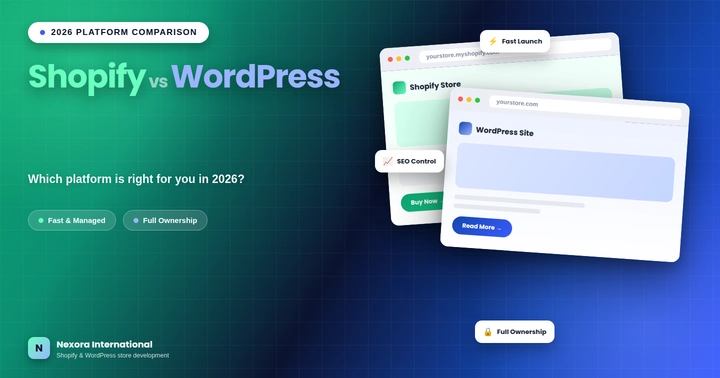
Choose Shopify if you want to launch fast with hosting, security, and checkout managed for you – it’s the better fit for most beginners and product-first brands. Choose WordPress with WooCommerce if you want full ownership of your code and data, deeper SEO and content control, and lower long-term costs – it’s the stronger fit for content-driven brands and teams with technical resources. Neither platform is universally better; the right choice depends on your business model and technical capacity.
What’s the Core Difference Between Shopify and WordPress?
Shopify is a hosted, all-in-one ecommerce platform built specifically for selling. Hosting, security, checkout, and updates are bundled into one monthly subscription. WordPress is a free, open-source content management system that becomes an ecommerce platform through WooCommerce, a plugin you install yourself. You choose your own hosting, own all your code and data, and manage updates yourself – or hire someone to.
| Shopify | WordPress + WooCommerce | |
|
Type |
Hosted SaaS platform | Self-hosted, open-source CMS |
|
Hosting |
Included |
Purchased separately |
| Setup Speed | Fast, no code required |
Slower, more configuration |
|
Ownership |
Platform-controlled | Full code & data ownership |
|
Market Share |
6M+ live stores (2026) |
Powers 41.9% of all websites |
| Best For | Fast-launch, product-first brands |
Content-led, SEO-focused brands |
Cost Comparison: Shopify vs WordPress in 2026

Shopify costs are predictable; WordPress costs are variable but often lower in the long term. Shopify’s Basic plan starts at around $39/month, but the realistic total cost — including payment processing, essential apps, and backups – typically ranges from $89 to $549/month, depending on sales volume. At $10,000 in monthly revenue, fees alone often reach $240–$520/month.
| Cost Factor | Shopify | WordPress + WooCommerce |
| Platform/Software | $29 – $399/month | Free (WooCommerce plugin) |
| Hosting | Included | $5 – $50/month separately |
| Transaction Fees | 2.9% + $0.30 (Shopify Payments) | Depends on gateway chosen |
| Third-Party Gateway Surcharge | +0.5% – 2% | Usually none |
| Apps/Plugins | $10 – $100+/month | $0 – $100+/month |
WordPress is often marketed as “$150/year,” but that figure ignores hosting, premium plugins, and security tools most real stores need — so the actual gap between platforms is smaller than either marketing page suggests.
Ease of Use and Setup Time
Shopify is built for non-technical users and can go live in days. Everything — theme, payments, shipping, hosting — lives in one dashboard with no code required. WordPress has a steeper learning curve. You’re selecting hosting, installing WooCommerce, configuring plugins, and managing updates yourself, which takes longer but gives you control Shopify doesn’t offer by default.
Customization and Ownership
WordPress offers effectively unlimited customization because it’s open-source — you have full access to the underlying code and can build or modify almost anything. Shopify is customizable within its theme and app ecosystem, but you’re working within a platform you don’t own. As one 2026 comparison put it plainly: with Shopify, you’re building on rented land.
This matters most for drag-and-drop page building. WordPress’s built-in Gutenberg editor gives free layout flexibility. Shopify requires a third-party app for the same kind of drag-and-drop editing — typically $12.99–$19.99/month extra.
SEO and Content Marketing
WordPress generally offers stronger SEO control, particularly for content-heavy strategies. It provides deeper access to technical SEO, metadata, schema markup, and blogging infrastructure — WordPress was originally built as a blogging platform, and it shows. For ecommerce brands planning to drive traffic through long-form content, guides, and organic search rather than paid ads alone, this is a meaningful advantage.
Shopify’s built-in SEO tools are solid for standard product and collection pages, but its blogging functionality is comparatively limited without added apps.
Security and Maintenance
Shopify handles security, PCI-DSS compliance, and platform updates automatically. There’s nothing to patch or monitor yourself. WordPress puts that responsibility on you — plugin updates, security monitoring, and backups all need to be managed, either personally or through a maintenance service, since vulnerabilities in outdated plugins are a common attack vector for self-hosted sites.
Scalability for Growing Brands
Both platforms scale — the difference is how. Shopify scales by upgrading plans (Shopify Plus for high-volume enterprise brands) and adding apps. WordPress scales through hosting upgrades, custom development, and a growing plugin stack. Brands with unusual technical requirements or highly specific workflows often find WordPress’s flexibility easier to scale around; brands that just need more sales volume on a standard store usually find Shopify simpler to scale.
Quick Decision Framework
- Want to launch in days, not weeks? → Shopify
- Want the lowest possible long-term cost and don’t mind managing hosting? → WordPress
- Building a content/blog-first brand around organic SEO traffic? → WordPress
- Want hosting, security, and checkout handled for you? → Shopify
- Need highly custom functionality outside standard ecommerce features? → WordPress
- Selling straightforward products with no unusual technical needs? → Shopify
Common Mistakes When Choosing a Platform
- Picking WordPress for “lower cost” without budgeting for hosting, premium plugins, and security — the real cost gap is often smaller than expected
- Picking Shopify assuming SEO is equally strong out of the box — it needs more app support to match WordPress’s native content tools
- Ignoring technical capacity — WordPress rewards teams with development resources and can become a maintenance burden without them
- Choosing based on price alone instead of what the platform needs to actually do for your specific business model
Final Verdict
There’s no universal winner between Shopify and WordPress — both power millions of serious ecommerce businesses. Shopify wins on speed, simplicity, and managed infrastructure. WordPress wins on ownership, customization, and SEO depth. The right answer depends on whether your priority is getting to market fast or building a fully owned, content-driven system for the long term.
Nexora International builds on both Shopify and WordPress, and helps brands choose the platform that actually fits their goals — not just the one that’s trending.
FAQs
Is Shopify or WordPress cheaper?
WordPress software is free, but hosting, plugins, and security tools add real cost. Shopify starts at $39/month with hosting included. Total costs often converge more than the “free vs paid” framing suggests.
Which platform is better for SEO?
WordPress generally offers stronger SEO control, especially for content-heavy strategies, due to deeper technical SEO access and native blogging tools. Shopify’s SEO is solid for standard product pages but weaker for content marketing without added apps.
Do I need coding skills for WordPress?
Not strictly, but WordPress has a steeper learning curve than Shopify. Managing hosting, plugins, and updates is easier with some technical comfort or a developer’s help.
Is Shopify or WordPress more secure?
Shopify handles security and PCI-DSS compliance automatically as part of the platform. WordPress requires you to manage plugin updates and security monitoring yourself, or hire a maintenance service.
Can I switch from WordPress to Shopify later, or vice versa?
Yes, migrations between platforms are common, though they take planning to preserve SEO rankings, product data, and design. It’s easier to choose carefully upfront than to migrate later.
Which platform is better for a small business just starting out?
Shopify is usually the faster, simpler starting point for beginners with no technical background. WordPress fits small businesses that already have development support or plan to invest heavily in content marketing.